9 Minutes To Read

Changing Hillside Economy: Farmers Turning from Opium to Coffee and Tea

9 Minutes To Read
  • English
  • Yaw Bawm Mangshang shares a hopeful story of environmental recovery in Shan State.

    In today’s world, the daily news is overwhelmingly bleak with both man-made and natural disasters. Uplifting stories feel almost nonexistent. This article stands out as a rare positive story to come out of Myanmar, telling a hopeful story of environmental recovery and of efforts to reduce further degradation caused by slashandburn opium cultivation. It is especially significant given Myanmar’s position as the world’s leading opium producer and its vulnerability to natural disasters.
    The Green Gold Cooperative (GGC) is a group of coffee farmers in southern Shan State, the area where much of Myanmar’s opium cultivation is concentrated.

    They have seen success developing a  legal alternativelivelihood development initiative, and their practices may be valuable for future development programs in Myanmar and beyond.

    UNODC’s Alternative Livelihood Development Program

    In 2014, with initial funding from the European Union, Germany, and followed by Finland from 2016 until 2025, the United Nations Office on Drugs and Crime (UNODC) introduced coffee in the project areas  (mainly Hopong and Loilem townships in southern Shan State) with the belief that highquality specialty coffee has strong potential to serve as a viable legal alternative to opium poppy cultivation. 

    In 2015, UNODC helped to establish the Green Gold Cooperative, a coffee farmer-led organization. By engaging farmers, the community would be able to produce enough specialty coffee to support a sustainable business, gradually shifting the local economy from opium to coffee.

    The GGC now has over 1100 members focused on producing and marketing high quality coffee. The GGC members collectively now manage over 1100 hectares of coffee plantation. In the harvest season of 2025, the highest performing farmer proudly told this author that his gross revenue from coffee was over 70 million Kyat (around USD 17,000).

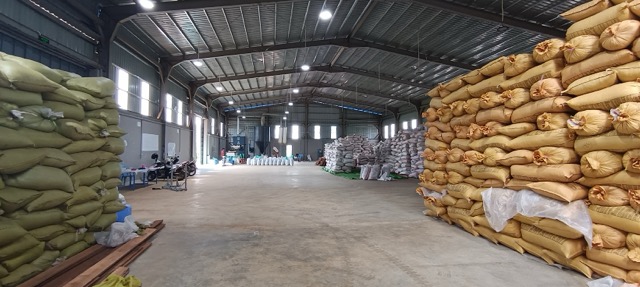
    Green Gold Cooperative factory in Hopong. (Photo by UNODC, 3 July 2024)


    Positive impacts on environmental and land conservation 

    In addition to reducing opium poppy cultivation, the project also aimed to address environmental degradation, including deforestation. It is fair to conclude that these objectives have been achieved in the project areas.

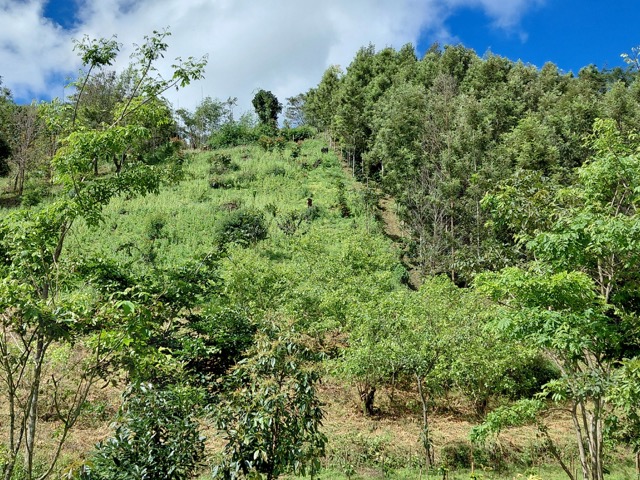
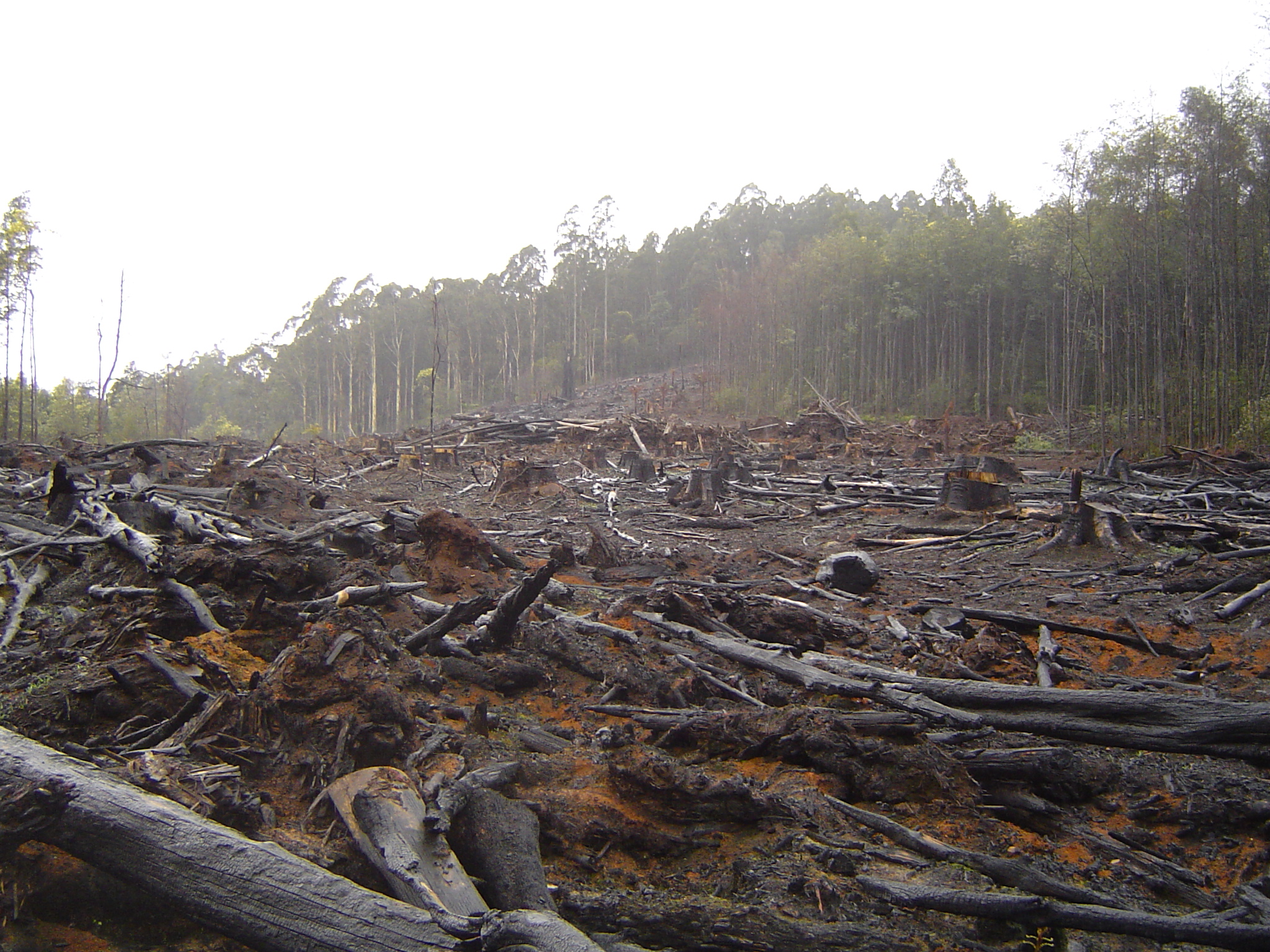
    It is truly pleasing to see the complete transformation of landscapes – areas once stripped bare by opium poppy cultivation have become lush, green coffee plantations. From a distance, these plantations are almost indistinguishable from natural forests. This is possible because coffee trees thrive under shade, whereas opium poppies require direct sunlight, which leads to total forest clearance for opium farms, accelerating topsoil erosion and land degradation.

    A 2014 coffee plantation (right), resembling natural forest, contrasts sharply with the bare‑tree opium poppy field on the left—now being restored, as the farmer has already replanted it with coffee. Tha Hlya Noe (Ta Lya Noe) Village, Hopong Township. (Photo by Mangshang Yaw Bawm, 13 November 2025)


    Having recognized coffee as a viable alternative livelihood crop, many communities beyond the project areas are now adopting it through their own initiatives. During my field research, I observed many small-scale seedling nurseries, mainly coffee and shade trees, set up in family gardens. I learned that families with limited land engage in seedling production as a small business, earning over 2,000 Kyat per plant. They do not even need to handle transportation, as buyers come directly to purchase from the site. This is another positive impact because the expansion of coffee plantations also contributes to environmental conservation by reducing barren hills and preventing topsoil erosion.

    Contributing factors of success

    The project’s success began with UNODC’s thorough assessment of local conditions (including climate, elevation, and socioeconomic factors), which led to the intentional selection of coffee as a viable and legal alternative livelihood crop to growing opium poppies. Producing highquality specialty coffee was essential, as only a premium product could command prices high enough to offer farmers substantial returns. Since opium is profitable, farmers needed strong assurance that coffee could generate income that is at least comparable, if not greater, for the transition to be worthwhile. The following are contributing factors for the success of the GGC program, which could be lessons for future livelihood programs in Myanmar and beyond. 

    (1) Selection criteria for initial beneficiaries

    As this is an agricultural project, UNODC prioritized selecting beneficiary farmers who possess at least 1.5 hectares of land and demonstrate willingness to join the program during the initial phase. Although there was initial concern that this approach would exclude landless families who need help the most, it turned out to be a practical and correct decision. 

    The coffee program so far proves to be beneficial for wider communities. For instance, families with limited land now engage in seedling production and landless families provide labor for weeding, coffee cherry picking, and processing on coffee farms. 

    (2) Organizational structure promoting empowerment

    The UNODC project supported the formation of GGC, a member-focused organizational structure that empowers members. It allows them to elect their own representatives to the key decision-making board, which maintains a 50/50 gender balance between men and women. The board is responsible for establishing policies, rules, and procedures that govern GGC operations. To reduce the risk of misuse, a transparent management structure and clear decision-making processes have been proactively designed.

    (3) Direct supports to beneficiaries 

    Efforts to provide material and technical support directly to the beneficiaries have proven effective, because if they continue relying on assistance from implementing agencies, they will likely face difficulties when those agencies experience funding cuts or reductions. Therefore, while funding is available, priority should be placed on strengthening both individual and organizational capacities so that beneficiaries become selfsufficient and ultimately no longer dependent on external support.

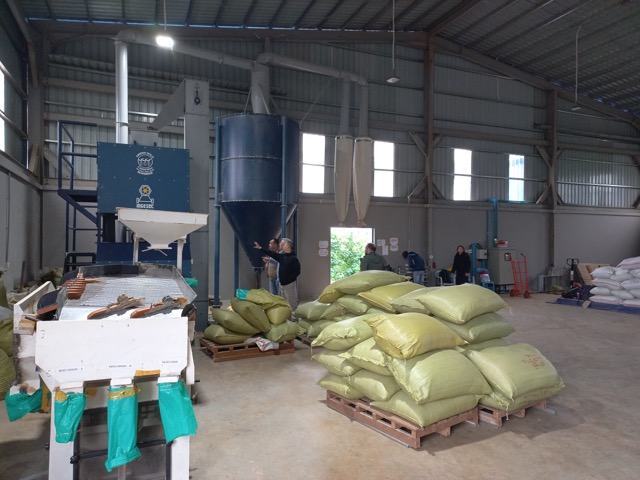
    Direct support includes the provision of materials and technical assistance to the beneficiaries, both individual farmers and collective groups such as GGC and Tai Lon (a tea farmers-led organization). Material support for individual farmers includes items such as coffee seedlings, shade trees, and fertilizer. For collective or common use, supports include higherbudget items such as land for GGC factory and office buildings, coffeecherry pulping machines, villagelevel storage facilities, green-houses for women in villages, and coffee drying and sorting machines for GGC. These material supports were widely recognized as a critical factor for success. These are big-cost items which cannot be expected from beneficiaries, especially in the early phase.

    Finland’s Head of Mission visits the now largely self‑sufficient Green Gold Cooperative factory in Hopong. (Photo by Mangshang Yaw Bawm, 7 November 2024)


    Likewise, technical support is provided at both the individual and GGC cooperative levels. At the individual level, this includes technical expertise in areas such as coffee plantation management, maintenance in line with Fair Trade and Organic standards, cherry picking, and both wet and dry processing methods. It also includes training in tea leaf-processing techniques for tea farmers, particularly members of Tai Lon. 

     At the collective level, support focuses on strengthening GGC staff capacities through training in quality sorting, roasting, cupping (tasting), financial management, organizational development, marketing, and logistics. As a result, both GGC and the coffee farmers have become largely selfsufficient.

    Additionally, training was provided to members of community forest groups on developing and implementing their own forest management plans, as well as writing annual reports for submission to the relevant authorities. This is essential because the validity of community forest certificates depends on the proper management of the forests.

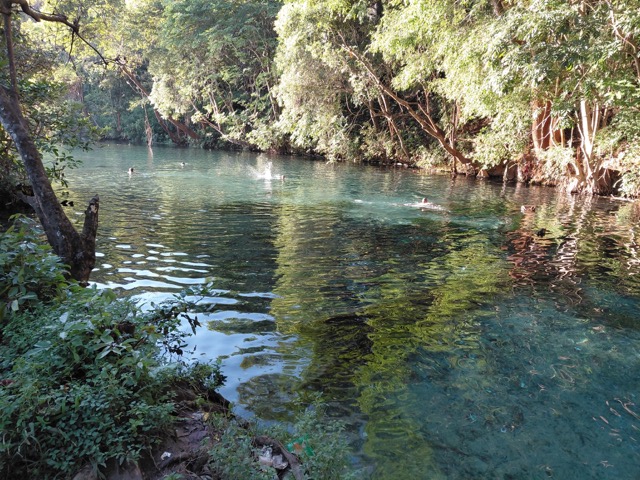
    Finland funded the reforestation and gap‑planting of over 150 hectares in the watershed area of the well‑known Maingpone Spring (also known as Naung Cho Lake). (Photo by Mangshang Yaw Bawm, 12 November 2025)

    (4) Well-coordinated support and decision making

    The steering committee (SC) of the project includes representatives from all key partners (i.e., donors, the implementing agency, government, and beneficiaries). Before February 2021, the SC meetings were well attended by the representatives from the embassies of Finland, Germany, Switzerland, and respective Myanmar Government ministries as well as from Malongo (a French coffee firm), UNODC, and Green Gold Cooperative. 

    At the SC, members discussed and made key decisions on priorities such as capacitybuilding needs, highlevel coordination and engagement, and overall program design. The SC meetings also served another, arguably even more important, function; alleviating potential concerns of the host government, given that the project areas fall within complex governance contexts where control is shared or contested between the government and ethnic armed organizations.

    (5) High-level field visits facilitate political buy-ins 

    A key lesson learned is that political stability is essential for the success of livelihood development programs. Programs of this kind require longterm donor support, and for donors to maintain their commitment, they must be able to travel to project sites and directly observe the progress and results in the field. 

    Before February 2021, UNODC managed to organize several joint and separate highlevel field visits involving senior officials from relevant government agencies, the representatives of Ethnic Armed Organizations (EAOs) that signed Nationwide Ceasefire Agreement (NCA), diplomats from donorcountry embassies, and senior officials from donorcountry headquarters.

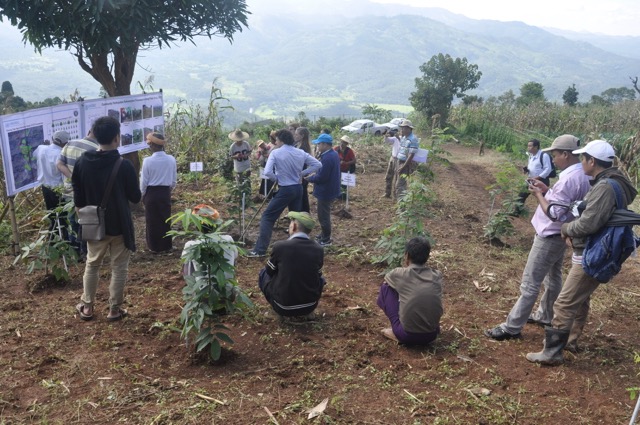
    A high-level joint field visit with representatives from donors, government, and EAOs. (Photo by Mangshang Yaw Bawm, 17 October 2017)


    These field visits were beneficial for all parties involved for their continued political support. Because the project areas were “gray zones” under the overlapping administrative influence of both the government and the EAOs, the visits allowed officials to observe the actual progress on the ground.

    For  the embassy staff and officials from donor countries, the visits provided an opportunity to see the real conditions and tangible results of the program. This helped them demonstrate to their constituencies (taxpayers) that the funding has been used in a meaningful and impactful way.

    For the beneficiaries, many of whom were initially uncertain about whether they would be able to sell their products, the highlevel visits served as reassurance that their efforts would not be wasted. In other words, these visits increased beneficiaries’ confidence and strengthened their hope in the project.

    (6) Long-term commitment of donor supports

    Ten years of Finland’s support to the program has been greatly appreciated and recognized as a contributing factor for success. This is not to suggest that shortterm support is any less important; every form of assistance plays a critical role in helping communities transition from scratch to a new alternative livelihood crop instead of opium poppies.

    However, longterm commitment of donor support gives both the beneficiaries and the implementing agency greater predictability in planning and implementation. It eases beneficiaries’ anxiety, as it is unrealistic to expect immediate benefits. This is because coffee requires at least three years before it begins to bear fruit. During the first and second harvests, farmers focus on learning processing skills such as picking, pulping, drying, and cupping. By the third harvest, they become much more competent, and they begin to taste the actual benefits of these skills and labors.

    (7) Having a buyer or market

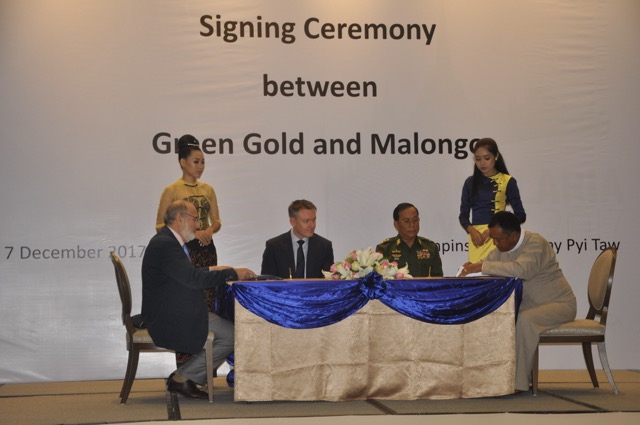
    Having a stable market (buyer) was a key factor for success. Fortunately, a French coffee company, Malongo, signed an agreement with GGC to purchase the coffee, which reassured farmers who were initially uncertain about their ability to sell. The signing took place in 2017, when the threeyearold coffee trees planted in 2014 had just begun to bear fruit. By then, the plantation area was already large enough to produce commercially-viable quantities, with additional hectares planned for expansion. This scale provided buyers with sufficient confidence to view Myanmar as a promising source of highquality specialty coffee. The early commitment from the buyer, in turn, motivated more farmers to join the program, ensuring a reliable production volume.

    Signing partnership agreement between Green Gold Cooperative and Malongo in Nay Pyi Taw. (Photo by Mangshang Yaw Bawm, 7 December 2017)


    Conclusion

    The project began in 2014, at a time when Myanmar was experiencing a renewed sense of political stability following the 2010 elections and the signing of the Nationwide Ceasefire Agreement (NCA) in 2015. This period of relative calm provided the foundation on which the initiative could establish and nurture a thriving coffee sector. Thanks to continued donor support, even through the challenging period following February 2021, coffee has since emerged as an important new agricultural export, bringing muchneeded hard currency into the country. 

    As Myanmar remains one of the world’s top producers of opium, with cultivation practices that accelerate environmental degradation through widespread forest loss and slashandburn clearing, the need for sustainable alternative livelihood programs is undeniable, and so is the need for donor engagement. Ultimately, the success of programs like this rests on two pillars: a stable political environment and direct, sustained support to beneficiaries that equips communities to build resilient and lawful livelihoods.


    Yaw Bawm Mangshang has worked as a National Program Officer, and Political & Development Officer at the Embassy of Finland in Yangon for over 10 years, during which the UNODC project was among his areas of responsibility. He declares no conflict of interest in writing this article; his sole intention is to share good practices that contributed to the project’s success, as these insights may be valuable for future development programs in Myanmar and beyond.

    Related Articles

    Stay in the loop.

    Subscribe with your email to receive the latest updates from Tea Circle.
    This field is required.