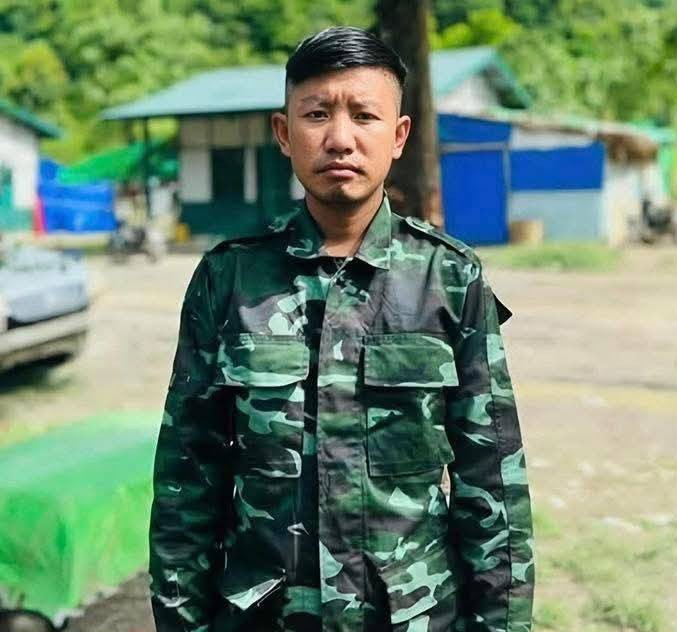
Emily Fishbein remembers Salai Ngun San Aung, a Chin activist.
Salai Ngun San Aung, a former journalist and campaigner with the Chin National League for Democracy, led peaceful protests in the Chin State capital of Hakha following the 2021 military coup. When the junta cracked down with lethal violence across the country, he was among an early wave of people who took up arms. He was a founding member of the Chinland Defense Force-Hakha, one of numerous ethnic Chin forces established in western Myanmar after the coup. It aligned itself with the Chin National Army, a longstanding group which seeks the self-determination of ethnic Chin people within a federal democratic Myanmar.
Salai Ngun San Aung went on to serve in various leadership positions with the CDF-Hakha as it drove the military out of villages across the township and established the foundations of home rule. He also lost many of his peers and comrades during these years.
I met Salai Ngun San Aung in September of 2022 at the CNA’s headquarters of Camp Victoria, when I was conducting interviews about the Chin national identity and Myanmar’s Spring Revolution against military rule. He shared his perspective on these topics, as well as his personal story including his relationship with his father, who was a major source of inspiration in his life.
His father passed away in January of this year. Shortly after, Salai Ngun San Aung died of an undetermined illness. He was 36, and left behind a wife and young daughter. This is a transcript of my interview with him, lightly edited for length and clarity.
I am Salai Ngun San Aung from Hakha. I was studying for my master’s in history at Yangon university, but because of COVID, I had to stop attending school. COVID continued, and I became the youth leader of a political party in Hakha during the elections. I was the campaign manager for someone who ran for the pyithu hluttaw. After the coup, I was a leader during the peaceful demonstrations. After the SAC issued an arrest warrant for me, I joined this armed revolution. At the start of the CDF Hakha, I was the media and communications spokesperson, and then after the elections, I became Assistant General Secretary.3
There are revolutions all around the world. The revolution at hand is not just an armed revolution; it is a revolution of all kinds. From a human rights and administrative perspective, the Myanmar revolution concerns our whole lives, so it is different from others. Before, Myanmar was one of the richest countries in the world. It had many natural resources. But over the past 70 years, it saw one of the most dramatic downfalls in the world. It became one of the poorest countries with the fewest opportunities. Setting aside material and financial aspects, we lost many human rights and I didn’t even know that we were losing them. We thought it was just a normal process. We lost our education, health and wealth. Our God-given state, our world, our land, our culture, our identity were swallowed. That is why now – I don’t know about other people, but for us, I see this revolution as saving our Chin State, our Chin ethnic people. We have reached a situation where we need to protect our country. We aren’t invading other countries, but we’re fighting this one battle to save our land, our culture, our whole lives which were taken away.
In 1895, we were administered by the British, and then Japan, and we gained independence together with the Burmese from the British, and we agreed to establish a national union. After peace was achieved, although we were in the union, we weren’t regarded as [our own] people in the union; we were regarded as people under them. So we agreed to have self-determination, but in reality we didn’t get it. We haven’t had this right since 1895. We have never had it in our lifetimes. So now we have reached the time to achieve it. If we don’t have self-determination, they determine us. If the government system is good, then the people can live in prosperity.
It is good to have self-determination in a liberated area, but when a battle happens in Myanmar, we face difficulties, and also in our social lives. Our mentality is that we are always afraid to meet the SAC, but some places are peaceful to live in. On the other hand, we are worried about whether our sons, daughters and comrades in battle are safe. We can’t yet talk about whether self-determination will benefit us or not; we are so worried about those in battle and we are very mentally exhausted. I can say that if we win this battle – even though Chin State doesn’t have gold or oil, we want self-determination, to control and manage by ourselves this God-given land which our grandfathers and grandmothers protected and shed sweat and blood for, our nation, our ethnicity.
If we can live together as a family and love each other as brothers and sisters, we truly want to live alongside them [the Burmese]. If they guarantee to give us the rights that we want, we can accept it. The first thing is to beat the SAC. After that, the Burmese and the Chin, Kachin, Shan, Mon etc, who live in the mountainous areas will negotiate for the administrative structure.
In our area, in rural areas and in villages outside of the city, we can say we have control. Although we don’t have 100% control, the people are safe, we have started opening schools, and we are providing medical care as much as we can. Health care needs technology, and we don’t have enough doctors and nurses, so there are still some areas that we can’t cover, but for security, we are able to take responsibility for the people’s safety. But across all of Chin State, the main administration is in Hakha, and the SAC is doing whatever they can to protect Hakha town. If Hakha is liberated we can declare the whole state as liberated. All the SAC’s strategic offices are in Hakha. The GAD for the whole state is based in Hakha, workers’ salaries are withdrawn from the Myanmar bank in Hakha, and their district office is in Hakha as well. They will do whatever they can to control Hakha, so we can’t operate a civil administration in the city. They are occupying the city, and that is why we are facing difficulties. We aren’t able to run an administration as much as we want, because in some sectors, we have to manage some aspects from the town, and we can’t take the town yet. Our journey is being delayed by that. That is the most difficult aspect.
In the past – setting aside Chin State, there might not have even been a Chinland. During the British era, they did a survey, and they categorized people with similar languages and cultures as people of a similar origin. We were assigned in this way. In the past, Chin people didn’t have a king or a central administration. Mindat administered itself, and Hakha itself. There wasn’t a Hakha township. During the British time, in order to facilitate governance, they divided up townships and designated borders.
We want to regain Chinland, where there are people with similar cultures to us, and which was owned by our grandfathers and grandmothers during the British colonial era. We want self-determination in those areas and to bring back the Chin identity, not to lose the Chin identity. Some people can’t speak Chin language and speak Burmese though their parents are Chin. Religion is a personal choice, whether Christian, Buddhist or Muslim, but I want all Chin people to reclaim our identities and our essence. That’s what we are trying to do. It may not be called the Chin nation, but I want to bring back a Chin identity and Chin essence.
My father was a politician when I was young, and I listened to the radio a lot because there was no internet. I grew up in a village around 16 or 17 kilometers from Hakha, with around 90 households. My father would always listen to the radio and talk about politics, and I think it got into my blood. When I was at school, I couldn’t just stand and watch bullying happen. I stood with the underprivileged and those who got bullied. I studied Myanmar’s revolutionary history in school, and then I became a journalist for around six years. I learned about human rights, and I learned a lot about oppression and human rights abuses around the world. I was a history major, so I read about Chin and Myanmar history. When I had internet access, I always listened to talks and interviews. I realized that it was not how our lives should be, that we were being oppressed. When I was a journalist, I mostly covered government corruption and injustice among the people. That is on my mind.
The coup happened on February 1. On February 2, I came here with Phun Sang, my friend who has since died. Then I protested. At first, I wasn’t that active, but when we were protesting, all the people joined us. When I saw the extent to which the people couldn’t accept this military regime, the extent to which they resented this military and how much they wanted federalism and hungered for self-determination, I got more strength, day by day. No matter how tired the people were, even going the whole day without eating – and some people were really old, ages 60 or 70, and young children – when I saw the people participating, my father said, ‘Even if your hands or legs are broken, it is worth it.’
I could attend school or work, but the reason I do this is that I don’t want my sons and daughters to live like this. I don’t want the next generation to live this kind of life, even though they have all the same qualities as people in other countries. My father is 83. I am 33. My mother is over 70. I told them, ‘It is OK if I die. If I am arrested, it is nothing. I will do this work and follow my duty.’ My father always says, ‘If you die, that’s okay. If they arrest you, that’s okay. Be responsible for the work that you’re doing.’ My father said, ‘I am ready to hear the news, ‘Your son has died,’ but what I really don’t want to hear is, ‘Your son has given up the revolution and came back.’ So I can’t say how much I need to sacrifice in this life. I may even die or something may happen to me before the revolution is done. But I will be really happy to see this revolution end in my generation and for us to achieve the goal that we want. If that doesn’t happen, I have decided to fight until I die. My father said, ‘Never turn back. I don’t want to hear people say my son has given up fighting in this revolution. I can still accept it if my son dies in this revolution.’ Therefore, I have decided to fight until I die.
One last thing. Between 2010 and 2020, we can say that we experienced a democratic government. It wasn’t a complete democracy, but when I look back at that time, it was a very happy time. Our infrastructure development improved, and our education system, though it wasn’t a true democracy yet. If we get federalism, we can form the government and system that we want. Looking back, as people my age and older may know, before 2002, we were living in slavery and we were being determined. We didn’t get to determine and make decisions for ourselves; they [others] determined how much we should get or what we should do. Everything was determined by them. Do we want to go back to that life? It is said that we fought the British for independence. Though we still celebrate independence day, did we really get independence?
This war must include all people in Myanmar – Burmese, ethnic nationalities, everyone. For this regime to fall, for our dreams to be achieved, everyone in Myanmar needs to join this battle. I call on all readers in other countries to help Myanmar in this revolution. Myanmar can become a leg, a hand or a body part in the world’s peace process. If there is no peace in Myanmar, it will affect the whole world. For federal democracy, I want the whole world to support us and I want everyone within Myanmar to join together during this time. And I would like to emphasize to the people and ethnic groups in Myanmar that now is the time to exert all the strength we have and push together for democracy.
Emily Fishbein is a freelance journalist focusing on Myanmar and currently serving as a Rainforest Investigations Network fellow supported by the Pulitzer Center. She interviewed Salai Ngun San Aung before she began her fellowship.
Notes
Like This Article