
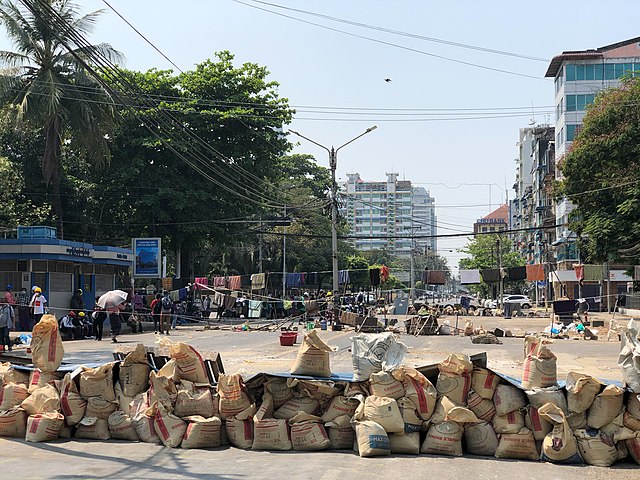

Myat describes how the Spring Revolution transformed patriarchal norms into a powerful resistance tool.
Introduction
The military is a socio-political institution where patriarchal values are highly rewarded and honored. According to Raewyn Cornell (1995), the military is a crucial area for study to identify hegemonic masculinity, and patriarchal norms. As a country that has experienced over six decades of military control, Burma is a compelling case to analyze how military and patriarchal values work together as an intertwined system of power. Since 1962, the military in Burma has institutionalized masculinity and patriarchal values as a way of motivating soldiers, structuring their conduct under the regime’s logic. This symbolic power was contested when the 2021 military coup led to Sarong movements (Htamein). During protests, women hung traditional sarongs and underwear across streets to obstruct military movement, exploiting soldiers’ beliefs that walking beneath women’s garments would spiritually degrade them. By using the traditional gendered norms of the military, the Htamein revolution challenged both the military and gendered norms. Women were key actors in the waves of protests following the military coup of 2021, attacking not only the military regime’s illegitimacy, but also its underlying patriarchal values that underpin the logic of how the military works. In this context, gendered norms that have seen women’s bodies as degrading became a tool for resisting the military, disrupting the military’s security circulation. This paper argues that the Burmese military has historically employed normative, patriarchal ideals as a form of governmentality to impose its power on both soldiers and society. In response, the post-coup ‘Htamein’ protests and campaigns embodied in women’s bodies represent a form of counter-governmentality. This symbolic defiance rooted in gendered cultural taboos aims to dissolve the authority of militarized patriarchy and destabilize its power.
Background of Context
According to the Global Firepower Review, Burma’s military is ranked 37 out of 145 countries, despite the country being a member of the least developed countries (2025 Myanmar Military Strength, 2025). In 2014, 14% of the government’s total expenditure was spent on the military, although the true figure may be higher (Steinberg, 2021). Three years after the 2021 military coup, the military’s spending surged up to 66 percent, approximately constituting $5.0 billion, the highest among Asia and Oceania (Stockholm International Peace Research Institute, 2025). This extensive investment in military capacity is justified through its claims to legitimacy. By presenting itself as the primary guardian of national stability, the military justifies its dominance through a gendered “protector” narrative. Claiming themselves as the protector of the state from both external and internal enemies, and treating the state as always in need of protection reflect the broader gendered roles of reinforcing masculinity as the governing rationale. This framing allows the military’s dominance while feminizing the state and its populations as vulnerable and dependent. The military-drafted 2008 constitution officially refers to women as “mothers,” which reinforces the idea of the need for protection. This emphasizes the role of women as passive receivers who need protection, sidelining the broader role of women as active agents (Mra, 2021).
Militarism itself is a manifestation of patriarchal values. According to Burke (1988) and Enloe (2007), “militarism is the set of material and ideological manifestations that promote militaristic values such as a belief in hierarchy, obedience, and the use of force in the political, social and economic domains” (as cited in Elveren & Moghadam, 2019, p. 3). These values are often reflected in patriarchal values that promote hierarchical gender roles, defining masculinity as the trait of “real men”. The feminist scholar, Cynthia Enloe, underlines that one of the core elements of militarism is the oppression of women (Enloe 1983; Burke 1998 as cited in Elvern & Moghadam, 2019, p. 3). This is exemplified through the Burmese military’s deployment of gender-based violence and rape, and weaponizing them as a tool of war. There is a vicious circle here: patriarchal values empower militarism, while militarism reinforces gender norms, consolidating power structures in a way that makes them increasingly hard to disassemble.
Militarism and Patriarchy as Intertwined Forms of Governmentality
The military sustains itself through militarized masculinity, reflecting patriarchal values as normative powers to shape the conduct of soldiers; it sidelines women from the sphere of power. In Burma, the military has maintained its image as a savior or guardian of the country. This ideology is rooted in their historical struggle for independence against the British. After independence from the British in 1948, when the country struggled amid competing political and ideological factions, the military reinforced its role as the protector of national unity, preventing the disintegration of the Union. That ‘savior’ ideology within the military positions them at the top of the hierarchy. Consequently, by invoking its role in the anti-colonial struggle against British rule, the military constructs an ideology that presents itself as the only institution capable of safeguarding national unity, thereby justifying its continued hold on political power. According to Michael Foucault (1977), “governmentality” does not operate solely through coercive force but also through the construction of normative behaviors that guide the conduct of targeted subjects. In Burma, the military has long used the slogans that say ‘Only the army is father, only the army is mother’ (Steinberg, 2021). Taking the parental role of the country, it has allowed the military to justify its long-standing power as if it is the only capable actor to protect the nation. Although the army claims to embody both the roles of a father and a mother, it does not challenge patriarchy. Instead, it is only used to justify its portrayal of the protectors’ role in which the governing rationale is embedded in a hierarchical form of authority. That authority continues to privilege masculine norms of control, discipline, and domination, reproducing the patriarchal system.
Collen Burken (2012) underscores that the militarized society is founded on a dominant-submissive relationship, which is perceived as necessary for social stability. In Burma, soldiers are indoctrinated to believe their roles are indispensable for the country’s stability. The “manliness” of soldiers is associated with order, discipline, aggression, and willingness to take risks. That manliness is fundamental to soldiers to belong to the military, in sustaining its longstanding image as the protector of the country (Tapscott, 2020). In this way, patriarchal values are institutionalized and venerated to promote the ideals that can shape the conduct of the soldiers. Those ideals can be found explicitly in the Army’s propagandistic narratives such as “ရဲရဲတိုက် ရဲရဲချေမှုန်း” (fight with bravery and destroy enemies with courage). According to research by Duke University, one drill instructor described manliness and masculinity as crucial to the military for dominating the enemy, and associated warrior spirit with brotherhood and paternalism (Morrist, 1996). This suggests that the military constantly needs a strong ideology that can mobilize soldiers beyond institutional command. The current military coup leader, Min Aung Hlaing, claimed “Tatmadaw (Military) is fearless and blameless and afraid of no one” in state media, reinforcing the militarized masculinity (Selth, 2021, p.25). The aggressive masculinity is needed to socialize the subjectivities of “a good soldier”. Aggressive masculinity is needed to socialize soldiers into the subjectivities of a “good soldier.” This means the military shapes how soldiers see themselves, what they value, and how they behave. Through training, discipline, and everyday military culture, soldiers learn to internalize aggression, obedience, and loyalty as central to their identity. Over time, they begin to think, feel, and act in accordance with the military’s ideals, seeing themselves as the “ideal soldier”. In this way, subjectivities—the inner sense of who they are—are molded to match the expectations of militarized masculinity. Instead of enforcing rules, the creation of an image of ‘a good soldier’ allows the soldiers to conduct themselves. As a result, patriarchy and the military reinforce and strengthen each other.
The military in Burma does not only conduct the soldiers through normative power but also co-opts the general public to its self-sustaining “protector” narrative. Instead of relying on coercion and physical violence alone, the military portrays the militarized patriarchy through education, media, and religion. Education under military rule emphasizes the differences between male and female gender roles. In school curricula, male domination is depicted through illustrations of pre-colonial kings as warriors and the glorification of victories in territorial expansion across borders. The depiction of males as warriors reinforces patriarchal norms, excluding women from the public sphere; it reduces their roles to supporting the male in the domestic sphere (Hedström & Olivius, 2022). In addition to the curricula, the schools’ rules and practices are militarized. For instance, obedience, discipline, and hierarchy are highly encouraged. The military’s decades-old slogan, “National discipline starts from school,” explains how Burma’s army instills patriarchal militaristic values among the population. Moreover, morning assembly, marching, uniforms, rigid school rules, and rote learning styles carry military characteristics. Although these norms seem neutral, the military in Burma has long sustained control over civilian institutions, including education. The rote-learning style in Burma has been criticized as part of the military’s broader strategy to instill discipline and obedience (Phattharathanasut & Brehm, 2025). Critical thinking in education is seen as a threat by the military juntas, as the educated public could challenge their authority. Instead, obedience is highly valued. Apart from the curriculum, the military has a system of military training for college students (Human Rights Approach, 2024). These programs, institutionalized under the reinstated 2010 People’s Military Service Law, involve drills, combat exercises, and ideological instruction designed to cultivate loyalty to the regime. This demonstrates how the military uses education to reinforce its style of thinking, characterized by domination, hierarchy, and obedience. Additionally, the military-run media emphasize the soldiers’ honor and pride by broadcasting the victories of the combats as well as the sacrifices of soldiers to protect the country. A military-controlled channel called Mya Wa Di regularly broadcasts movies that depict soldiers as the sole protectors of the country, sacrificing their lives on the frontline. Recently, the movie named “The Red Blanket” has won many awards at the Myanmar Film Award Ceremony, featuring the distorted version of the military’s soldiers protecting the civilians and fighting back the enemies (Mathieson, 2023). Although the military has killed thousands of civilians and bombed villages by air strikes, the media’s portrayal depicts the soldiers’ lives as ones of nobility, and reads their militarized masculinity as a form of protection.
Moreover, the patriarchal norms of the military in Burma can be profoundly seen in the guise of religion. For instance, the military-backed United Solidarity and Development Party enacted the Race and Religion Protection laws in 2015. Among the four laws that were passed, the Myanmar Buddhist Women’s Special Marriage Law regulates the intermarriage between Buddhist women and non-Buddhists (Rahman, 2015). The law requires Buddhist women to publicly announce their intention to marry non-Buddhists (Tun, 2023). If there is an objection to the marriage, the case will be taken to the local court. According to Human Rights Watch (2015), the law is discriminatory and completely violates the equal protection of the law and freedom of religion. This law regulates women’s bodies and justifies it under the pretext of protecting Buddhism. By controlling who women can marry, the military reinforces its role as a protector of religion. The military’s regulation of women’s private lives and personal choices shows how patriarchal norms and militarism reinforce each other. The military uses legal and religious frameworks to exploit women’s bodies as a site for consolidating its political and ideological power.
These empirical cases collectively illustrate how the military constructs the hierarchical gendered roles of the military and its masculinity, and how militarism and patriarchy are mutually constitutive. These symbolic features of the military as the protector of the state, the religion, and the race depend on patriarchal ideals. In such a way, these ideals are normative, shaping both soldiers of the institution and influencing the public’s perception by normalizing the military’s violence and suppression to an extent. Those facades were unmasked until the 2021 coup.
Women’s Bodies as A Resistance Force and a Counter-Governmentality
Despite the patriarchy embedded in militarism, post-coup Burma has brought down the symbolic gendered taboos, which reflect the vulnerability of the systemic violent power of the military. Patriarchal values found in Burma’s army are related to the country’s cultural beliefs. Burma has a deep cultural understanding of putting men at the top of the social hierarchy owing to men’s superstitious possession of “Hpoun”, the spiritual power unlike women. Aligned with Melford Elliot Spiro’s (1993) argument on “Ideology of Superior Male”, the same socio-cultural understanding of ‘Hpoun’ is reflected in the patriarchal military logic where the hierarchical role of males is considered legitimate. This widely accepted recognition of “Hpoun” that only men can possess exacerbates gender divides, excluding women from important decision-making power and political involvement. As the recognition of “Hpoun” is based on a narrative of male dominance, it needs to portray the opposite narrative of women as inferior, lower in status, and submissive. Therefore, there is a common belief that the masculine power or “Hpoun” can be dismissed if they pass under a woman’s garments, especially sarongs and underwear. What is more, the menstrual blood is considered as dirty, impure, and degrading for men. Burma’s military’s high regard for manliness and male dominance became an area for resistance after the military coup in Burma in 2021. According to Mbeme’s idea drawn from Mikhail Bakhtin’s “grotesque body”, the power dependent on exaggerated symbols such as masculinity in this context of Burma can open spaces for resistance. After the 2021 coup, protesters used this logic. The pro-democracy protestors mocked the military’s masculinity and spiritual purity by hanging women’s Sarongs (Htamein) in public places. According to cultural beliefs, men lose spiritual power by walking under these garments. These women’s garments acted as barricades to delay security forces, and disrupt the circulation of the military in cracking down on protests and attacking innocent civilians. This act turned the military’s own gendered beliefs into a tool for resistance, using symbolism, laughter, and inversion, just as Bakhtin and Mbembe describe. As soldiers were reluctant to walk beneath these garments due to their entrenched taboos, these strategic “Htamein Protests” functioned as a counter-governmentality, as theorized by Michael Foucault. These powerful resistance techniques and campaigns could be analyzed through the lens of counter-governmentality and subversion of resistance.
One protester commented that “we have no weapons to harm them [policies and soldiers], but anything that worries or delays is our weapon” (Frontier Myanmar, 2021). By weaponizing the symbolic patriarchal values of the military, protestors inverted the military’s logic and rationale, assembling the powerful resistance. Instead of resisting power through direct confrontation or violent means, protestors took advantage of the same symbolic power that the military uses to govern bodies, space, and conduct. It demonstrates how these patriarchal values oriented in the military can be reappropriated as tools for defiance.
A second technique protestors have employed was publicly displaying menstrual blood on streets and attaching the coup leaders’ photos to menstrual pads painted red. This directly challenges the junta and military’s patriarchal logic by exploiting their deeply seated notion that empowers their masculinity and manliness, facilitating violent actions as a governing rationale. Moreover, protesters used menstrual pads stained with red paint and stuck them onto images of the junta. By associating regime leaders with menstrual pads, which the military perceives as polluting, protesters subverted the masculine ideals of the military. This symbolic defiance undermined the military’s self-image of strength and power.
In response to these acts, the coup leader, Ming Aung Hlaing, declared that hanging women’s undergarments is disrespectful to the Buddhist religion; so, they will take legal actions against those participating in organizing these protests. That indicates the military’s vulnerability to its own established gendered taboos and patriarchal values. Moreover, Ming Aung Hlaing also called on the public through the junta-controlled media to participate in the protection of the rights of women, portraying women as “subjects for protection”. This reiteration of positioning women as the passive recipients of males’ (military) protection reflects the toxic militarized masculinity (Mra & Hedström, 2024). These empirical cases denote the significance of power and resistance, underlining the vulnerability of power and the possibility of resistance. However, this protest trend also raises concerns when women’s bodies are used in attacking the military’s logic and supporters. The cartoon that calls out a teacher who did not join the civil disobedience movement highlights women’s bodies as sexually subordinate to the soldiers (Mra & Hedström, 2024). This kind of portrayal follows the harmful practice of objectification of women’s bodies. To further strengthen the post-sarong movements in dismantling the patriarchal norms of the military, it is necessary to assess whether some of the strategies risk reproducing similar patriarchal practices.
Conclusion
Burma’s context highlights how militarism and patriarchy are deeply intertwined to enforce power by establishing normative ideals and governing rationale. The military exploits the deeply entrenched gender norms and patriarchal values to justify its recklessness and violence as necessary and just. “Protector” narratives are found in both militarism and patriarchy, reinforcing each other at the expense of women. Masculinity becomes a tool of governmentality, as the military sets normative standards for soldiers to follow without coercive command. Proving that male dominance is a strategy that makes soldiers believe in their roles as protectors of the country. The intertwined power of militarism and patriarchy in Burma not only motivates soldiers to voluntarily comply with the regime’s logic but also convinces the populations through subtle reinforcement in media, education, and religion. Although the symbolic power of militarized patriarchy seems so powerfully embedded in everyday life, it can be reversed by subverting these symbols. Burma’s post-coup Htamein Movement challenge both military and patriarchal values by turning women’s bodies from traditional subjects of protection into active agents of change. The use of women’s bodies and gendered taboos on menstrual blood becomes a site for counter-governmentality to disrupt the power and resist the imposed patriarchal values of the military as the governing rationale. This analysis highlights how even deeply rooted power structures are vulnerable and how counter-governmentality forces of resistance can expose and destabilize them.
Myat is a senior student from Burma, majoring in Politics, Philosophy, and Economics, with research interests in women’s rights and international relations. She is currently working as a co-founder of a regional initiative that provides leadership development training to women across Southeast Asia.