

Jane M Ferguson explores a recent approach to question gender dynamics in Myanmar expertise.
Events in Myanmar provoke global news headlines in ebbs and flows. In recent years, the Southeast Asian country has been notorious for its political disasters, which include ethnic cleansing, authoritarian repression, and its ongoing war. Political scientist Mary Callahan observed, “throughout the region, political power is in the hands of specialists in violence” (Callahan 2007, 2). Who, then, are the specialists about those specialists in violence? Where do people turn to gain a better understanding of the situation and to strategize for building a different future? Beyond journalist print media and news updates, the public turns to discussions by informed experts, whether they are assembled in public-facing panels or stored in think tanks.
Panel event notifications are well-distributed via email lists and social media posts. The increased shift toward on-line events during COVID facilitated transnational panels to pop up like mushrooms, and to be attended potentially by anyone with an internet connection. The lead-up to Myanmar’s 2020 election, followed by Min Aung Hlaing’s 2021 coup d’état, inspired hundreds of on-line panel discussions. As avid and critical Myanmar news followers, activists from the umbrella organization Women’s League of Burma (WLB) observed a gendered patterning in panel announcements. Over, and over again, Myanmar issue panels consisted of male speakers only (aka manels). Two WLB activists in particular, Nang Moe Moe and Ying Lao, embarked on a data-gathering mission: to document the preponderance of manels, saving copies of those panel announcements in an electronic folder. Over 28 months, they counted a total of 158 manels of 364 male presenters about Myanmar issues (Nicha and Raslaphas 2024).
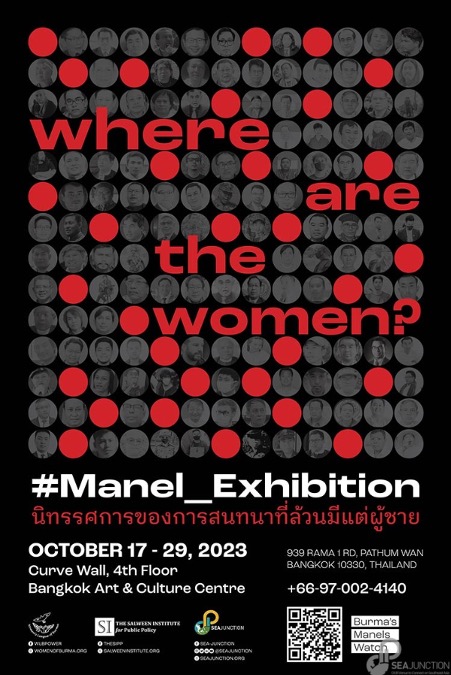
Drawing on their collection of scores of manel ads and graphics, on 8 March 2023, as part of events for International Women’s Day in the Northern Thai city of Chiang Mai, WLB members set up an artistic installation, “Manels: All Male Panels of Burma.” Their tagline was, “A manel a day keeps democracy away.” The exhibit included humorous satire graphics and mosaics comprised of manel posters, their male busts staring out of the posters. A prominent caption asked, “Where are the women?”
Contextualizing the manel critique in global feminist and academic discussion, this article will explore how the #Manel_Exhibition struck a chord in post-coup Myanmar political activism. The installation, as well as its responses, drew upon local and transnational ideas about expertise, democratic work, and how each is valued. Then, based on a quantitative study of recent mixed-gender Burmese and English language panel discussions, this article will examine and present data regarding proportional gendered “airtime” of Myanmar political expertise. Integrating the findings of the study with the themes of the #Manel_Exhibition debate, this article reflects on perceptions of expert knowledge and power, and how they might challenge or run roughshod over other voices.
Manelfold Issues
The word manel is a portmanteau of “male panel.” The term gained currency in the mid-2010s, partly to do with the trending tidal wave spurred by American author Rebecca Solnit’s 2008 essay “Men Explain Things to Me.” In the essay, Solnit told a personal anecdote of a meeting with an overconfident man who presumed her to be an ingénue. In ignorant hubris, the man proceeded to tell her about a book she herself had written. The famous essay led to the popular adoption of the term “mansplaining.” In a later reflection about the implications of her essay and the central concept, Solnit clarified, “… mansplaining is not a universal flaw of the gender, just the intersection between overconfidence and cluelessness where some portion of that gender gets stuck” (Solnit 2012).
The word mansplaining is now included in many dictionaries and official language lexicons. The Merriam Webster Dictionary defines the term as follows: “of a man: to explain something to a woman in a condescending way that assumes she has no knowledge about the topic.”1
In addition to netizens of varied stripes, the term mansplaining was quickly embraced by feminists in academia. For example, academia-geared spin-offs included two crowd-sourced blogs, “Academic Men Explain Things to Me” (https://www.tumblr.com/mansplained) and “Congrats, you have an all male panel!” http://allmalepanels.tumblr.com. The former consisted of anonymous experiences and personal anecdotes of mansplaining. The latter blog, however, employed a strategy to name and shame the organizers of academic events for not including women’s voices. Each blog post contained a specific event notification for an all-male panel, with a superimposed certification badge, featuring American actor David Hasselhoff (or as the blog calls it a ‘Hoffsome stamp’) posed in a confident “thumbs up” stance. Hasselhoff is thus appropriated to mime, “Congrats, you have an all male panel!”
While the internet quickly facilitates the collective discussion and experience of a novel concept (hence the term “going viral”), academia has formal venues for a discursive intervention. Some academics might use their forums to make a space for longer-term contextual introspection, engagement, and even change. Regarding manels, several academics have done studies and presented their findings in peer-reviewed academic journal articles. Articles with explicit manel critiques have extended to fields such as pharmacology (Bouvy and Mujoomdar 2019), medicine (Kibbe and Kapadia 2020), urology (Teoh et al 2021), oncology and radiation oncology (Kamran et al 2023; Burgess et al 2024), and surgery (Burton et al 2023). Despite the terms “mansplaining” and “manel” being of feminist humanities provenance, critical mobilization of the term for academic analysis and introspection seems to be singularly dominated by medical fields. On the other hand, it may stand to reason that it is the doctors who would seek to be quick to assess the extent to which their bodies have been afflicted by manelism, and then to strategize how to treat it.
One exception to medical disciplines’ domination of manel excision procedures is an Open Society Foundation (OSF) initiative, An End to Manels. The project analyzed 122 European high-level policy events, evaluating their gendered composition and compared their distribution across the kinds of topics that tended to generate different patterns of gender composition. Among other findings, the report observed that certain sets of issues were “extraordinarily male” in their speaker selection. These topics included: Foreign Policy; the EU; Crime, Terrorism and Security; Economic Situation; Environment, Climate, and Energy Issues; and Technology (Morehouse 2018, 1). Considering the Open Society Foundation’s findings in tandem with Myanmar’s reputation in the global media, then it is unsurprising, therefore, that international discourse about the country would track towards male expertise.
Myanmar’s 2021 military coup cracked open a veritable cornucopia of delectable issues for the approaches described as “extraordinarily male” in the OSF report. However, this should in no way suggest that Myanmar’s politics is singularly rendered a passive object for (white) manalysis. Ongoing analytical work and gendered critique continues in local forums which are arguing against regional dynamics of gendered privilege in addition to home-grown chauvinism. The Women’s League of Burma attracted both praise and malaise for having made these patterns legible through their #Manels_exhibition.
Myanmar Manels Confronted: Is it Defamation?
As mentioned in the introduction to this article, the #Manel_Exhibition was first on display in Chiang Mai as part of International Women’s Day celebrations in March 2023. They held the event at the Lan Din Café. Visitors strolled along paths between the billboards, looking at the posters and placards of the exhibition. After the #Manel_Exhibition made a splash in Chiang Mai, the Bangkok Arts and Culture Center invited them to mount the installation the following October. The Bangkok installation included larger storyboards in Burmese, Thai, and English. One of the advertisements for the October event received over one thousand comments on Facebook, ranging from praise, hearts, and confirmation, to laughs, derision and comments which questioned the intent and value of the work. Although the installation was in English, Ying Lao added that there was a Burmese portmanteau for manel: sakya waing (စကျားဝိုင်း “’machonversation’ circle” – saka waing being a conversation circle, yaukya meaning a guy).
A common response was a discomfort, or perception that the installation was shaming the individual men or seeking to divide the democracy movement. Nang Moh Moh commented, “We are not working to embarrass the men involved in this photo, but to show the organizations that are working and supporting the people. Our purpose is to ensure that women’s participation in panel discussions and debate is viewed as a key issue” (BNI 2023). Ying Lao2 affirmed that the poster was not intended as a personal attack on the individual men, and noted the character of the backlash, “When we made the poster with the faces of the men on manels, we put as the caption ‘Where are the women?’ Some of the men got angry with us, asking if we had permission to use their image on the poster. The images were already public. They wouldn’t have a problem with our poster if we had put, ‘Myanmar’s New Leaders.’ The pushback was harsher just because we asked, ‘Where are the women?’”
The Discourse of Sacrificing Soldiers
Another common retort to the #Manels_exhibition project was, “What about the combat soldiers at the front line?” The question usually is taken to have two insinuations: 1, that the front-line soldiers are men; and 2, their work is the most valuable in the fight against the military junta. Aside from the fact that many of the anti-junta platoons do include women soldiers, the person making that retort is not himself a soldier at the front line, he just associates himself via proxy masculinity, as it were. Even though liberation armies have historically been more attuned to gender dynamics than those of the oppressing state, they are often still quintessentially masculine institutions (Enloe 1983, 160, 220).
There is ample evidence of gender preferences and notions of male prestige in the armies of Myanmar’s various ethnic separatist forces, despite their histories of greater gender-inclusive soldiery than those of the state forces. These include those of the Shan, an ethnic nationality with military forces active since 1958. For example, in a 2005 issue of the Shan independentist magazine, Kon Hkaw, the author of the article “Shan Women Honored,” started the piece, “It was a difficult pill to swallow for most Shan men who had risked their lives and broken their backs working for the freedom of their people. But the fact remains that their battles, whether victorious or lost, have not been accorded the honor they deserve. Instead, it has been the Shan women who have burst open into the arena with their powerful report License to Rape… ” (Kon Hkaw 2005, 18). Rather than congratulate the women for their work in bringing serious abuses in Shan State to global attention, the author chose to focus the lead sentences on Shan men feeling upstaged.
Although the initial and widespread recognition of the Shan Women’s Action Network (SWAN) report was over two decades ago, chauvinistic attitudes persist within the Shan liberation movement. For example, some men have referred to integrated Shan armies though a short rhyme: tap kha lai, tap pum lai (တပ်ႉၶႃလႆၢး တပ်ႉပုမ်လႆၢး). Tap hka lai means “striped leg army” referring to the black leg tattoos that are a traditional Shan marker of masculine, martial prowess. Tap pum lai, on the other hand, means “striped belly army,” referring to the stretch marks left by pregnancy. As the #Manels_exhibition organizer Ying Lao noted, even though the rhyme acknowledges the presence of women soldiers, it is inappropriate and disgusting to body-shame women soldiers.
Add Women and Stir?
While the #Manel_exhibition brought attention to de facto gender-selective practices endemic in Myanmar news and political panels, what can be done to move forward? Ying Lao commented that one of the most common excuses organizers gave was that they could not find any women experts on their topic. “Some manel organizers responded and asked us to furnish a list of qualified women for their panel. They turn it back on us and make us do more work to furnish a list. Why are only men on their lists?” Her frustration stems from knowledge of many smart, talented women, while the fact remains that some men would only think of other men.
Tokenistic practices, such as selecting people based on their identity rather than for their skills, can lead to the incorporation of individuals who lack the necessary preparation for the job. The 2008 Myanmar Constitution’s reservation of 25% of parliament seats for the military is a prime example of tokenism. In terms of gendered representative tokenism, when the Nationwide Ceasefire Agreement (NCA) dialogues originally required 30 per cent women’s voices, the government responded by including U Aung Min’s wife and her various friends. They were not versed in the issues, nor did they have decision-making power (Zin Mar Phyo and Mi Sue Pwint 2023, 146). By fulfilling social identity quotas through the selection of yes-men and yes-women who are ill-prepared for the role, tokenism serves to worsen the dominant culture (Bridges 2014, 160). Tokenistic inclusion often selects individuals because of their lack of skill, or their conservative political alignment, so their presence will not threaten the existing power dynamic. Furthermore, interviews with women in Myanmar reveal that patriarchal mores often have the support of men and women (Aye Thiri Kyaw 2023, 64). Thus, the act of including women is not progressive, sui generis. One’s social identity is not indicative of their political sympathies, after all.
Beyond the issue of Manel composition, there is the key issue of who gets to express their ideas within panels. Presence on a panel does not guarantee that the individual will get the most airtime, nor does it prevent some panelists from running roughshod over the voices of the others. Ying Lao noted, “men have a sense of confidence to speak, even when they don’t have a point. Women are more careful.” This observation tracks across different occupations. Various management psychological studies confirm that women across diverse professions have often been slower than men to gain confidence in their skills and are less likely to take unnecessary risks such as operating machinery while intoxicated (Neal-Smith 2014, 194). In addition, women in male-dominated occupations concur that their work is often subject to a higher level of scrutiny than that of their male counterparts, or they are harassed in ways that are not only demeaning but also communicate that they are not welcome in those spaces (Smith 2013, 596; Gibbon 2014, 115).
Gender on the Air: A Quantitative Experiment
Ying Lao and Nang Moh Moh do not want to banish panels writ large; they simply want to see panels that are more inclusive. Not all panels are manels, after all. When a panel is gender-inclusive, does it automatically raise the voices of women or other marginalized people? Some gender-inclusive panels, because of the people on them and their internal dynamics, nevertheless privilege male voices and mansplainers.
To gather quantitative data on this issue, I used a methodology derived from corpus linguistics. From YouTube and Facebook, I assembled a corpus of panel videos on Myanmar news and politics: seventeen recorded panels on news and political analysis of Myanmar with 15 hours and 43 minutes’ panelist speaking time. These included eight English-language panels3 and nine Burmese-language panels4. All the selected panels had a minimum of three presenters and necessarily included both women and men. While my corpus does not portend to be comprehensive, its analysis does have the potential to indicate gendered dynamics in panel discussions of Myanmar issues today.
To measure “airtime” I employed a method which will be familiar to anyone who used a public phone in Myanmar as recently as the early 2000s: when a person started talking, I clicked a stopwatch and measured until they stopped. I kept a tally for each panelist and gradually added up the individual entries to get the sum speaking time of each person in the discussion. I also noted who the chair or moderator called on to present the first commentary of the event.
In the eight surveyed English-language panels, I measured a total of 9 hours and 40 minutes of panelist speaking time. The 22 men talked for 5 hours and 53 minutes. On average, each man spoke for 16 minutes. The 12 women talked for 3 hours and 47 minutes, so on average, each woman spoke for nearly 19 minutes. Although there were more men, and male voices occupied more time across the eight panels, proportionally, the women talked more than the men. Despite being outnumbered, women’s voices comprised a significant part of the airtime. In addition, the panels were even (4:4) in terms of which gender was the first to be called upon to speak.
In the nine Burmese-language panels, I measured a total of 6 hours and 3 minutes’ speaking time. There was less total talking time in the Burmese-language panels as the corpus includes several panels that were 30 minutes long. The 21 men talked for 3 hours and 59 minutes. On average, each man talked for 11 minutes and 43 seconds. The 12 women talked for 2 hours and 3 minutes. On average, each woman talked for 10 minutes and 12 seconds. A more significant divergence was that in 8 out of the 9 panels, chairs called on a male panelist to speak first. It’s possible that the mere act of calling on men to speak first effectively set the tone for who took up the most space. Even so, a difference of 91 seconds of airtime is hardly a vast gap.
Admittedly, this research design was inspired by my own experiences of having been victim to mansplanations. Those first-hand experiences crafted my expectation that I would find quantitative evidence of male dominance in these gender-mixed panels. However, the data speak otherwise. Despite being outnumbered, women held their own. Across multiple panels, women certainly and enthusiastically spoke their bit, occupying as much airtime as their male counterparts. Women doing work on Myanmar issues are hardly shrinking violets, and in several cases, it was a woman from Myanmar speaking English as a second (or third!) language who got her points across in the mixed-gender and mixed-nationality panel. Women who participated in these panels are not simply inserted as tokens; they know their stuff. To be sure, not all women were equally outspoken, and there was a great deal of variation across the 17 panels. We can also speculate that the women who are assertive in these panels are likely those with the guts to call out the manels.
Stop! Maneltime.
Where women are clearly strong contributors, in this political culture, then, why would manels persist? As a Kayin woman activist commented, “men don’t like women who try to solve problems, as their positions can be threatened” (Khin Khin Mra and Livingstone 2023, 41). In this way, an emphasis on the value of men’s status or, conversely, entrenched sexist ideas can be used to keep women out of certain jobs. For example, in reference to the taboo which prohibits women from operating marionettes on the puppet stage, yokthe marionette master Maung Htin Aung commented, “it (the taboo) may have been only an attempt by men to reserve the profession for themselves” (Singer 1992, 40).
While the #Manel_Exhibition was focused on Myanmar-related events, the provocation could well be wagered throughout Southeast Asia. Despite the region having been characterized by its premodern gender complementarity, the experiences of colonialism, Western religions, and capitalist modernity have recalibrated these power dynamics (Reid 2014, 147). Corollary institutions often maintain the status quo. For example, formal justice systems in Timor-Leste have “dismally failed” to treat intimate partner violence as a crime worth prosecuting (Wigglesworth et al 2015, 314).
Patriarchal institutions continue to marginalize women’s voices in the public sphere and diminish the importance of gender issues, including LGBTQIA+ rights. Military coups and democratic backsliding across the region do not bode well for future gender equality. However, as has been shown by feminist research, this hegemony is not complete. In the Indonesian armed forces, despite being cast as mothers and daughters for the nation, some women have been able to exercise agency and change the boundaries of nationalist femininity (Sunindyo 1998, 16). Recent feminist movements in Thailand have challenged the role of the monarchy, attacking it for its institutional role in political as well as gender repression (Pavin 2024, 1).
Returning to the radical goals of #Manel_Exhibition, they are not urging panels to replace male speakers simply because they are men. The point is to transform how knowledge and expertise are showcased, and to rid those processes of gendered presumptions. In international Myanmar studies and news circles, the public has been encultured to turn to white male voices as experts. When all the panelists are Asian, moderators tend to call on men first. There is an everyday gendered dynamic of men talking while others listen. However, as shown by the quantitative survey, women can and do rise to the occasion. Armed with these data, and the force of Manelfest Destiny, this paper concludes with a simple directive: Manelers of the world, unite more inclusive panels! You have nothing to lose but your shame.
Jane M Ferguson teaches anthropology and Southeast Asian History at the Australian National University.
Footnotes
- https://www.merriam-webster.com/dictionary/mansplain
- Ying Lao, personal communication.
-
The 8 English language Myanmar issue panels are as follows:
- “Panel Discussion on Events Since the Coup in Myanmar” — https://www.youtube.com/watch?v=1J55o_yAscI
- “Panel Discussion: ‘Why Has Myanmar’s Struggle for Democracy Been Ignored?” — https://www.youtube.com/watch?v=5-T_UNd0HTs
- “Panel Discussion-2020 Myanmar Elections” — https://www.youtube.com/watch?v=FxNrQgj4FBc
- “Myanmar in Crisis: the Way Forward – OPR Panel” — https://www.youtube.com/watch?v=sOWlfP9JDkA
- “Uprising Against the Coup: Myanmar and the Regional Struggle for Democracy” — https://www.youtube.com/watch?v=1DnxfeAcRKI
- “Law and Lawlessness: Myanmar Coup and Human Rights” — https://www.youtube.com/watch?v=Fd0qPeO7GgM&t=66s
- “Conflict and Political Crisis in Myanmar” — https://www.youtube.com/watch?v=1MhTakT-CGE
- “One Year after the Myanmar Coup” — https://www.youtube.com/watch?v=yTdsJUk78I4
-
The 9 Burmese language panels are as follows:
- ပိတ်ဆို့အရေးယူမှုတွေ ထိရောက်ရဲ့လား — https://www.youtube.com/watch?v=fHVN-iy68TA
- လက်တွေ့ကျတဲ့ တွေ့ဆုံဆွေးနွေးရေး — https://www.youtube.com/watch?v=uCOubIhTGdE
- တိုင်းပြုပြည်ပြု ၂၀၂၀စကားဝိုင်း – အမျိုးသားညီညွတ်ရေးအစိုးရ — https://www.youtube.com/watch?v=s2ugFmFs2Wc
- နိုင်ငံတကာအကူအညီတွေ့နဲ့မြန်မာဒုက္ခသည်အကျပ်အတည်ဖြေရှင်း နိုင်မလား — https://www.youtube.com/watch?v=88_nxFyyuv0
- အာဏာရှင်စနစ်၏ဘဏာတိုက်များ – ရေနံနှင်သဘာဝဓာတ်ငွေ စကားဝိုင်း — https://www.facebook.com/watch/live/…
- ဒို့ရဲဘော်နှင့် ထောက်ပို့ရဲဘော် စကားဝိုင်း — https://www.facebook.com/watch/live/…
- RFA စကားဝိုင်း နိုင်ငံရေးအကျဥ်းသားတွေကိုကွပ်မျက်ခြင်းရဲ့အကျိုးဆက်ကဘာဖြစ်လဲ — https://youtu.be/_xNInJq3AMU
- နိုင်ငံရေးပဋိပက္ခအတွင်း လူငယ်တွေ ဘယ်လို ဖြတ်သန်းကြမလဲ — https://www.youtube.com/watch?v=yWrF254XF7E
- မြန်မာနိုင်ငံသား စတော့စျေးကွက် ရင်းနှီးမြှုပ်နှံသူတွေ စကားဝိုင်း – DVB Talkshow — https://www.youtube.com/watch?v=1cuK77rVAxc
Bibliography
- Aye Thiri Kyaw. 2023. “Women’s Mobilisation, Activism and Policy-Making in Myanmar’s Transition” in Hedström, Jenny and Elisabeth Olivius, eds. Waves of Upheaval in Myanmar. NIAS Press. pp 50-69.
- Bridges, Donna. 2014. “Grounded? Female Pilots, Gender Identity and Integration into the Australian Defence Force.” in Donna Bridges, Jane Neal-Smith and Albert J Mills, eds. Absent Aviators: Gender Issues in Aviation. Routledge. pp 147-164.
- Bouvy, Jacoline C., and Michelle Mujoomdar. 2019. “All-male panels and gender diversity of issue panels and plenary sessions at ISPOR Europe.” PharmacoEconomics-open. 3(3): 419-422.
- Buchanan, Cate and Khin Khin Mra. 2024. Women, Peace, and Security Funding Dynamics in Myanmar, 2010-2020. International Peace Support and Effective Peacebuilding in Myanmar Series, the Asia Foundation.
- Burgess, Laura, Anushka Ghosh, Beow Y. Yeap, Nabeel Rasheed, Siri Ragala, Anita Nwiloh, Henning Willers, Anthony Zietman, Neha Vapiwala, and Sophia C. Kamran. 2024. “Recent Trends in “Manels” and Gender Representation Among Panelists at North American Annual Radiation Oncology Meetings.” International Journal of Radiation Oncology* Biology* Physics. 120(1): 23-28.
- Burma News International. 2023. “Nearly 160 ‘All-Male Panels (Manels’) held in past 3 years.” https://www.bnionline.net/en/news/nearly-160-all-male-panels-manels-held-past-3-years (Accessed: 22 October 2024).
- Callahan, Mary P. 2007. Political Authority in Burma’s Ethnic Minority States: Devolution, Occupation, and Coexistence. ISEAS Publishing.
- Fairbank, Viviane. 2020. “Why I Don’t Read Rebecca Solnit: It’s time to stop buying into the author’s brand of pop feminism.” The Walrus. 23 April 2020. https://thewalrus.ca/why-i-dont-read-rebecca-solnit/ (Accessed: 20 October 2024).
- Gibbon, Deanne. 2014. “Unexpected Turbulence: The Cultural, Gender-Based Challenges Facing Female Pilots in the Australian Defence Force.” in Donna Bridges, Jane Neal-Smith and Albert J Mills, eds. Absent Aviators: Gender Issues in Aviation. Routledge. pp115- 146.
- Kamran, Sophia C., Beow Y. Yeap, Anushka Ghosh, Christopher M. Aldrighetti, Henning Willers, and Neha Vapiwala. 2023. “Recent trends of “manels”: gender representation among invited panelists at an international oncology conference.” JNCI Cancer Spectrum. 7(2): 1-6.
- Khin Khin Mra and Deborah Livingstone. 2023. “When Heads of the Household become Heads of the Village: Gender and Institutional Change in Local Governance Settings in Myanmar” in Hedström, Jenny and Elisabeth Olivius, eds. Waves of Upheaval in Myanmar. NIAS Press. pp 29-49.
- Kibbe, Melina R., and Muneera R. Kapadia. 2020. “Underrepresentation of women at academic medical conferences—“manels” must stop.” JAMA Network Open 3(9): 1-2.
- Morehouse, Christal, Alla Garcia, and Silvia Fierascu. 2018. An End to Manels II: Closing the Gender Gap at Europe’s Top Policy Events: Open Society Justice Initiative.
- Nicha Wachpanich and Raslaphas Kaweewat. 2024. “A Male Face as the Future of Burma’s Democracy? Women Say No.” Visual Rebellion (https://www.visualrebellion.org/timeline/a-male-face-as-the-future-of-burmas-democracy-women-say-no, Accessed: 14 October 2024).
- Pavin Chachavalpongpun. 2024. “Long Live Patriarchy! The Thai Monarchy’s Position on Gender Equality and Justice.” Asian Studies Review: 1-19.
- Reid, Anthony. 2014. “Urban Respectability and the Maleness of (Southeast) Asian Modernity” Asian Review of World Histories 2(2): 147-167.
- Singer, Noel F. 1992. Burmese Puppets. Oxford University Press.
- Smith, Louisa. 2013. “Working hard with gender: Gendered labour for women in male dominated occupations of manual trades and information technology (IT),” Equality, Diversity and Inclusion. 32(6): 592-603.
- Solnit, Rebecca. 2012. “Men Explain Things to Me.” Guernica. 20 August 2012. https://www.guernicamag.com/rebecca-solnit-men-explain-things-to-me/ (Accessed: 15 October 2024).
- Sunindyo, Saraswati. 1998. “When the Earth is Female and the Nation is Mother: Gender, the Armed Forces and Nationalism in Indonesia.” Feminist Review. 58 (Spring): 1-21.
- Teoh, Jeremy Yuen-Chun, Daniele Castellani, Claudia Mercader, Alba Sierra, Flavio L. Heldwein, Erica On-Ting Chan, Marcelo L. Wroclawski et al. 2021. “A quantitative analysis investigating the prevalence of “manels” in major urology meetings.” European Urology 80(4): 442-449.
- Zin Mar Phyo and Mi Sue Pwint. 2023. “’I will Fight Such Dictatorship until the End’: From Student Rebel to Feminist Activist, Mother and Peace Negotiator” in Hedström, Jenny and Elisabeth Olivius, eds. Waves of Upheaval in Myanmar. NIAS Press. pp 138-149.
- ၵွၼ်းၶေႃ 2005 “Shan Women Honoured” 22 (220) p. 35
